

 Stories
August 19, 2026 • 3 min read
In Syria’s Jabal Al-Zawiya, the rehabilitation of critical water infrastructure, supported by the Syria Cross-Border Humanitarian Fund (SCHF), is helping thousands of families regain access to safe water and rebuild their lives after years of conflict.
Water is often one of the first services families look for when deciding whether returning home is possible. Without it, schools struggle to reopen, health centres cannot function effectively, and households face impossible choices between paying for drinking water or meeting other essential needs. Restoring water systems is therefore about far more than merely repairing infrastructure— it is about restoring dignity, stability and the conditions for recovery.
Returning Home
Abdul Latif Al-Yamani, known to his neighbours as Abu Ziad, returned home after years of displacement to find his house still standing. Little else had survived. The water station that once supplied his community lay in ruins.
“Water is the foundation,” he says. “It is the most essential element of life and stability.”
For Abu Ziad and his family, accessing water became a daily and costly challenge. Three families shared his home—his own household and those of his two married sons—and water became one of their biggest concerns.
“We had to buy it and transport it ourselves,” he recalls. “Five barrels cost about five dollars.” Every day, animal carts hauled water along dirt roads, just so his grandchildren could drink, wash, and cook.
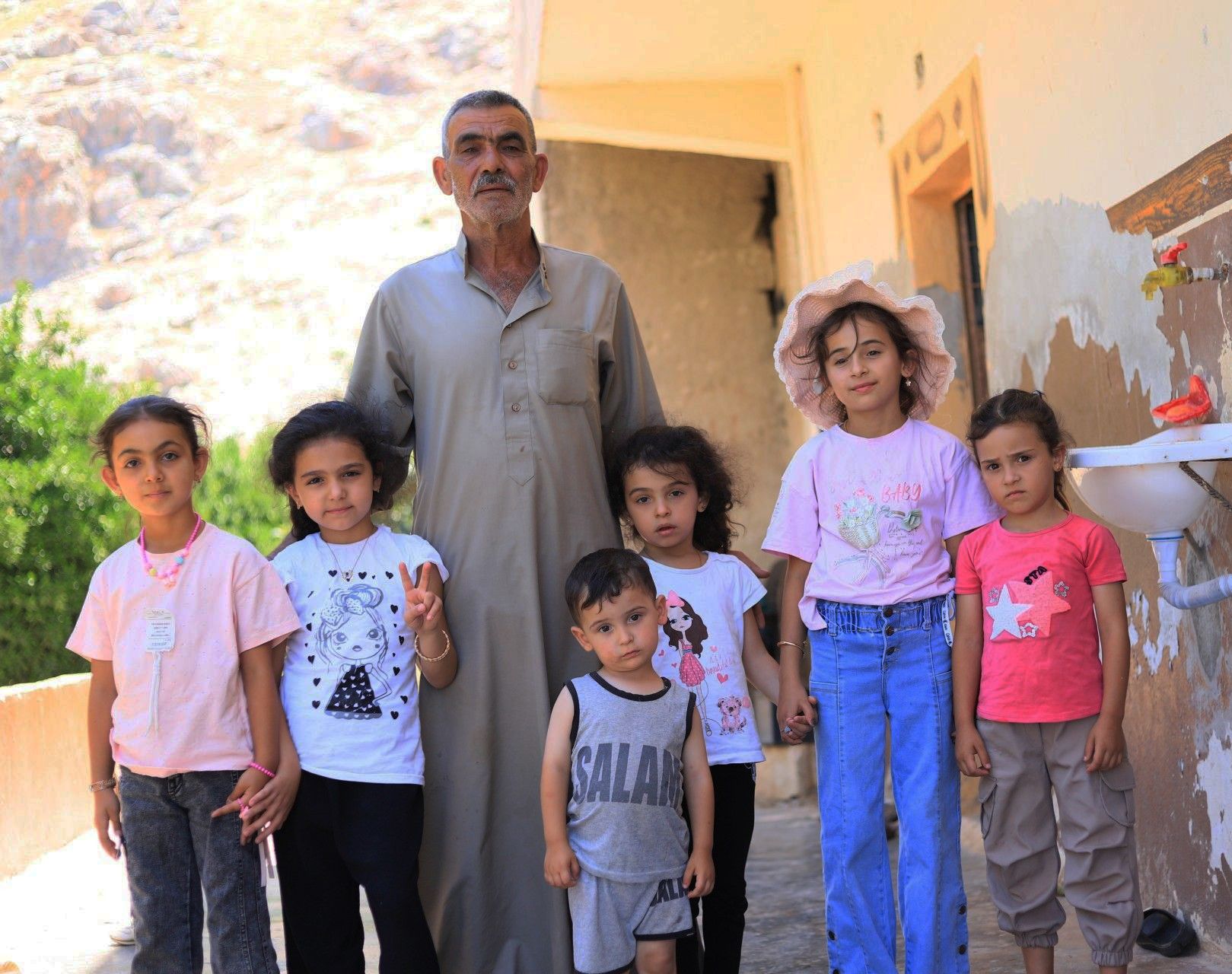
Abu Ziad stands proudly with his six grandchildren: 7-year-old Sham, 5-year-old Bayan, 3-year-old Abdul Latif, 5-year-old Jana Al-Yamani, 10-year-old Hala Al-Yamani, 6-year-old Jouri Al-Yamani
The conflict had already taken more than water. “One of my sons was killed during the conflict,” he says quietly. He does not dwell on the loss. Instead, he turned towards rebuilding what remained.
Restoring Critical Infrastructure
With funding from the SCHF, GOAL rehabilitated the Al-Laj water network, restoring critical infrastructure serving Abu Ziad’s community and 35 others across Jabal Al-Zawiya. The network is now operational in Abu Ziad’s community and is expected to reach approximately 60,312 people across 36 communities once fully connected.
For Abu Ziad, the change is already tangible. The barrels and animal carts are no longer part of the family’s routine—water now reaches their home directly through the restored network. What once cost the family close to $5 a day now costs them almost nothing, freeing up money that had gone toward buying and hauling water for food, education and other household needs.
Ali Al-Jasem, a mechanical engineer who has worked with GOAL since 2018, watched the impact ripple outward. “The moment the system started running, we began to see people actively repairing their homes,” he says. “People asked us almost every day when the water would arrive because they were planning their return around it.”
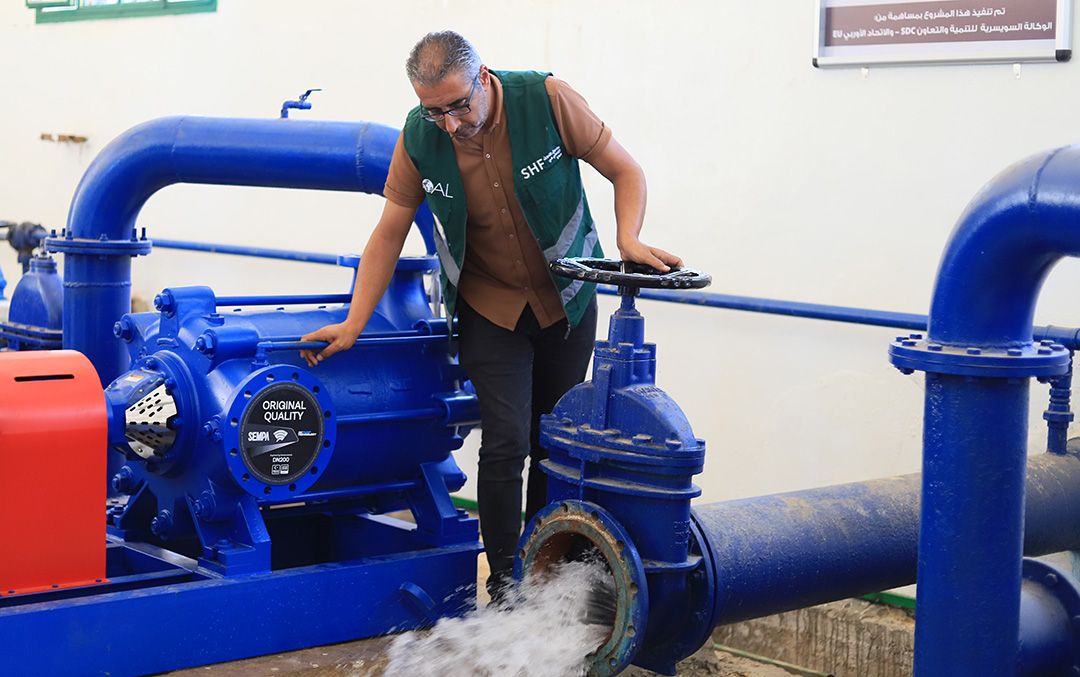
Ali Al-Jasem and his team have restored the water station in Jabal Al-Zawiya
For Abu Ziad, the greatest change cannot be measured in pumps or pipelines.
“We ask God that goodness comes to Syria,” he says, “and that he rewards everyone who contributed to this project for the great impact it has had in restoring life and stability to this region.”
It is measured, instead, in something quieter — the confidence that coming home might finally be permanent.
