

 Stories
March 12, 2026 • 3 min read
Families in Farda village, Kebribeyah district of Ethiopia’s Somali Region, have long faced limited access to safe water. An earlier water system provided only partial and unreliable service, forcing households to depend on unsafe sources. GOAL’s rehabilitation of the water scheme has restored reliable access for both people and livestock, reducing health risks and daily hardship. Further upgrades, including solarization and community management, are strengthening the system’s long-term sustainability.
Access to clean and reliable water remains a major challenge in parts of the Somali Region, where fragile infrastructure and recurrent climate shocks place pressure on limited resources. In the Kebribeyah district, water shortages have affected household health, education, and livelihoods, particularly for women, girls, and pastoralist families. Through its WASH programming, GOAL works with local authorities to rehabilitate water systems and support communities to manage them sustainably.
Limited and Unsafe Water Access
For many years, residents of Farda village struggled to access clean and dependable water. A previously developed water source was poorly constructed and relied on small plastic containers as reservoirs, limiting the amount of water available and the number of people who could use it. Frequent breakdowns further reduced access, and the system eventually stopped functioning altogether.
Dudi Hasen, a 40-year-old mother of four, explains how the situation affected daily life: “There was an attempt to provide us with clean water, but the supply was limited, and there was no facility for our livestock. Later, the system broke down completely. Mothers and girls were forced to travel up to four hours to fetch water from open and unclean sources”.
The consequences were immediate and far-reaching. Children were increasingly exposed to waterborne diseases, while women and girls carried the responsibility of water collection, often at the expense of schooling and childcare.
“Girls were overburdened and forced to drop out, and mothers were not able to properly take care of their children,” Dudi adds.
Rehabilitating and Strengthening the Water System
To address these challenges, GOAL, generously funded by the US government, conducted a detailed assessment in collaboration with district and regional water offices. Farda village was identified as one of the areas facing the most severe water shortages.
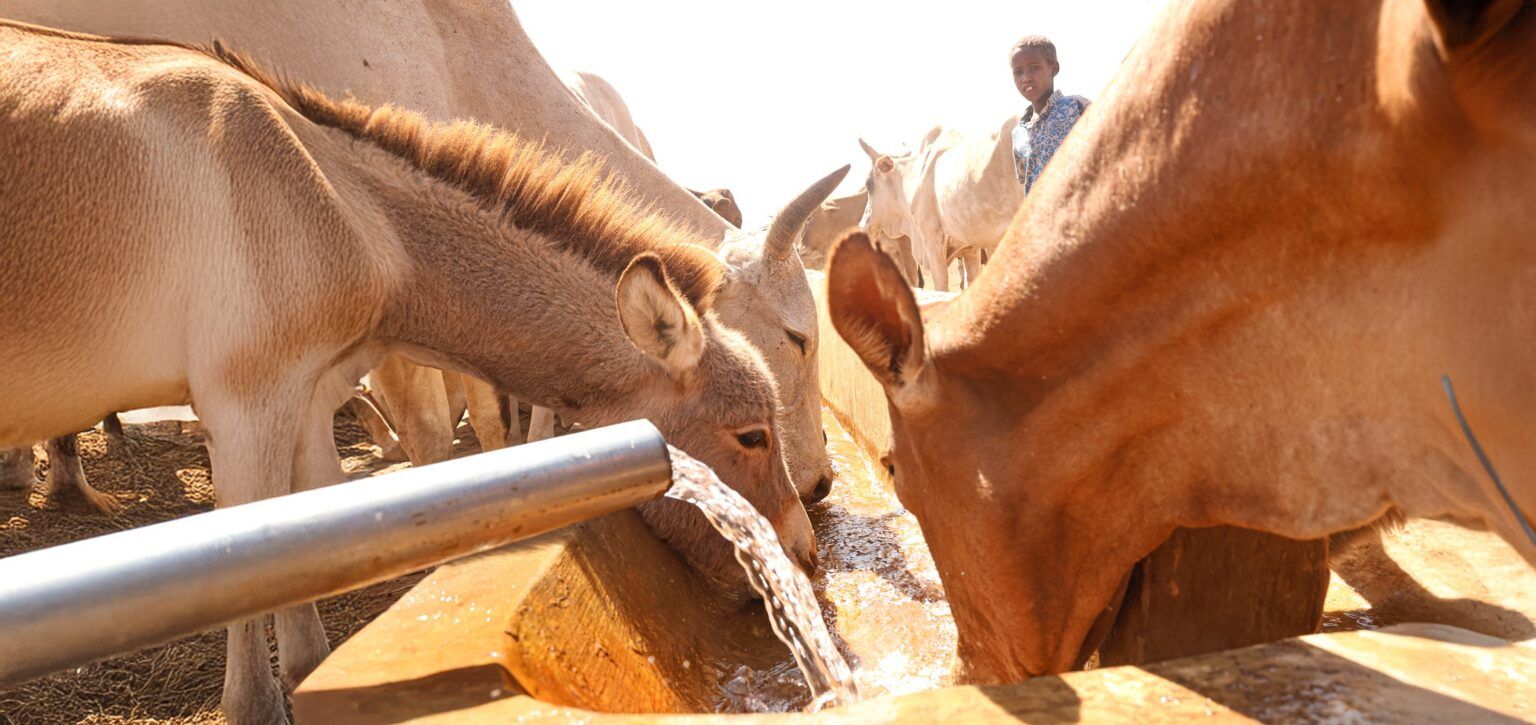
Abdi Omar, GOAL’s Deputy Area Manager, describes the intervention: “The work ranged from rehabilitating the existing water source to constructing a standard 25,000-litre water reservoir with multiple water points and a cattle trough.”
The upgraded system was designed to meet both household and livestock needs, reflecting the community’s reliance on pastoral livelihoods. Solarisation of the water point is now underway, and GOAL is supporting the community with training to manage and maintain the facility independently.
Reduced Burden and Improved Well-being
With the rehabilitated system in place, families no longer need to spend hours searching for water, and access to safer supplies has improved daily living conditions.
“After the restoration of the water facility, the challenges are almost resolved,” says Dudi. “We are no longer travelling for hours, and our girls are not suffering anymore.”
For livestock owners, the impact has also been significant. Muhumed Hashi, 63, a father of 14 children, recalls the earlier difficulties:
“When the water system was not operational, we transported water from far away and poured it into holes so our livestock could drink. Sometimes we had to buy water, and the cost was not affordable.”
Reflecting on the results, Abdi Omar notes: “We are grateful for the financial support from the US Government. Because of this support, children and mothers are no longer facing the same hardships, and the community is better prepared to manage this water source sustainably.”
