

 Stories
June 18, 2026 • 2 min read
In Niger’s Zinder region, recurring food insecurity leaves many communities vulnerable, particularly during the annual lean season. To help address this challenge, GOAL, with support from Mohammed Bin Rashid Al Maktoum Global Initiatives and Irish Aid’s Civil Society Partnership for a Better World, introduced a subsidized seed initiative providing improved and biofortified crop varieties to smallholder farmers. Farmers such as Bachir Zabeirou tested improved millet and cowpea seeds alongside traditional varieties and achieved significantly higher yields, strengthening household food security and resilience.
Communities across Niger’s Zinder region continue to face recurring food insecurity driven by low agricultural productivity, limited access to improved farming inputs, and harsh climate conditions. In Gueza Dan Alkali, a remote village of around 2,000 people, most families rely on subsistence farming and livestock herding to survive, leaving them highly vulnerable during the annual lean season when food reserves run low. To help address these challenges, GOAL launched an agricultural support project funded by Mohammed Bin Rashid Al Maktoum Global Initiatives and Irish Aid’s Civil Society Partnership for a Better World. The initiative provides at the last mile subsidized improved staple crops seeds (biofortified millet, improved maize, groundnuts and cowpea seeds) to smallholder farmers, enabling communities to test more resilient crop varieties.
Farming Under Increasing Pressure
Located in the arid Sahelian belt of Niger, Gueza Dan Alkali depends heavily on rain-fed agriculture. Most farmers cultivate staple dryland crops using traditional methods and have limited access to irrigation systems, agricultural technologies, or quality seed varieties.
For many households, these limitations result in consistently low harvests despite months of labor. Families often struggle to produce enough food to sustain themselves throughout the year, particularly as unpredictable weather conditions continue to affect agricultural production.
Bachir Zabeirou, a father of 15, is among the farmers facing these challenges. Supporting a large household through subsistence farming alone has become increasingly difficult as yields remain low and seasonal food shortages persist.
Introducing Improved Seed Varieties
Following assessments of the community’s agricultural needs, GOAL introduced a subsidized seed support initiative designed to help farmers improve productivity locally appropriate solutions.
Bachir participated in the pilot by planting improved pearl millet and cowpea seeds on part of his farmland. The initiative encouraged farmers to test alternative seed varieties while continuing their regular farming activities, allowing them to compare results under local conditions.
Traditionally, local millet varieties in the area produce limited yields, often leaving farming households with minimal surplus for consumption or income generation.
Encouraging Early Results
The pilot initiative delivered inspiring results for Bachir and his fellow participating farmers. Improved pearl millet varieties significantly outperformed traditional local seeds, producing yields of 1.5 metric tons per hectare, three times of the 500 kg typically harvested using conventional varieties. This dramatic increase in productivity translated directly into greater food availability at the household level, strengthening families’ ability to meet their nutritional needs and build resilience against future shortfalls.
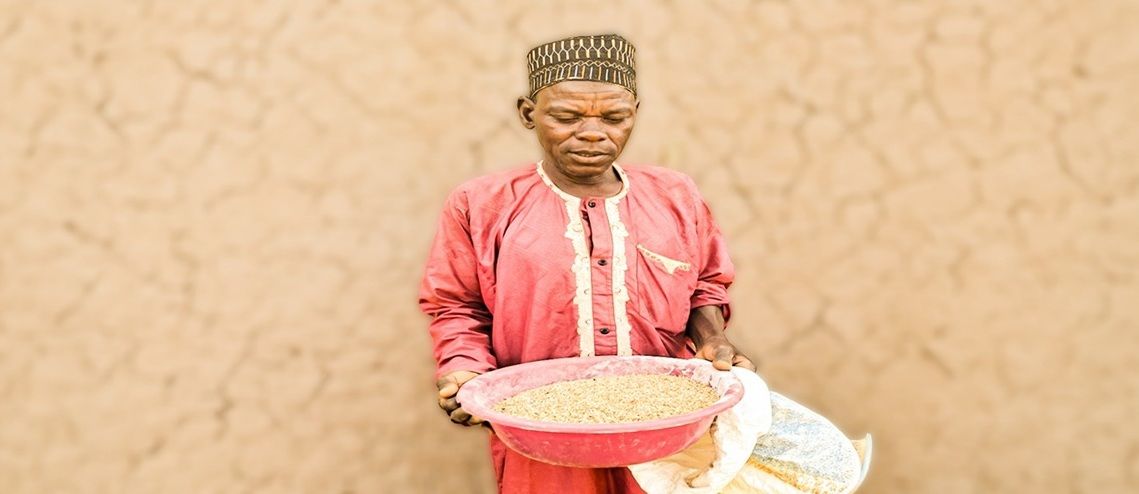
While the harvest increase alone is not enough to fully address the wider food security challenges facing the community, it has encouraged farmers to explore new agricultural practices and consider investing in improved seed varieties in future planting seasons.
The experience has also demonstrated the importance of providing practical, accessible support that enables rural communities to test and adopt approaches suited to their environment. For families in Gueza Dan Alkali, the initiative represents an opportunity to gradually improve resilience and reduce vulnerability to recurring food shortages.
