
 Stories
March 11, 2026 • 3 min read
In Akobo, South Sudan, widowed mothers face extreme barriers to earning a living, often relying on firewood collection or local alcohol sales to support their families. These survival strategies expose women to protection risks, contribute to environmental degradation, and strain household stability. Through the THRIVE project, GOAL and its partners are supporting vulnerable women with practical skills and startup resources to pursue safer, sustainable livelihoods. For women like Lima Nok, this support has opened new opportunities to generate income while strengthening family and community wellbeing.
Akobo is one of South Sudan’s most remote areas, affected by prolonged conflict, displacement, and recurrent flooding. Formal employment opportunities are scarce, and access to markets, goods, and services is limited. Women, particularly widows and women living with disabilities, often shoulder the responsibility of supporting entire households with few viable income options. The THRIVE project, funded by UKAid and implemented through a consortium led by GOAL, aims to address these challenges by supporting vulnerable women with integrated livelihood skills and startup assistance.
Survival Strategies with Lasting Consequences
In Akobo, many widowed mothers are the sole providers for their families after losing husbands to conflict, illness, or insecurity. With limited access to land, education, capital, or markets, income-generating options are extremely constrained.
For many women, survival has depended on collecting and selling firewood or brewing and selling locally produced alcohol. Firewood collection requires long and physically demanding journeys, often exposing women to protection risks while accelerating deforestation around already fragile communities. Alcohol production, though one of the few available income sources, can also contribute to household instability, including domestic conflict and reduced spending on essential needs.
These coping strategies reflect necessity rather than choice, trapping women in a cycle that undermines family stability, community wellbeing, and the environment.
Building Skills and Identifying Market Gaps
Recognising the disproportionate burden faced by widowed mothers and other vulnerable women, the THRIVE project identified women in Akobo for integrated short-term soft and hard skills training. The aim was to support them to move beyond survival-based activities and begin generating safer, more sustainable income.
“They provided us with different training, and it opened our eyes,” said Nyachiang Biel, a mother of five. “We learned to understand our environment, identify what is missing, and see where the gaps are. After the training, we were asked which business sectors we wanted to join.”
Akobo’s remoteness from Juba means most goods take a long time to arrive or must be imported from neighbouring countries. While delays are inconvenient for some items, limited access to essential daily products such as cleaning materials creates serious challenges. Affordability is an additional barrier for many families.
Seeing this gap, the trained women formed a group and decided to begin manufacturing liquid soap locally.
Sustainable Income with Community Benefits
VSF Suisse, a THRIVE implementing partner in Akobo, supported women with practical training in soap production and provided startup materials as in-kind assistance to launch their businesses.
“We were deliberate in our approach,” explained Issa John, THRIVE Project Manager with VSF Suisse. “From participant selection to training and startup support, the goal was to address interconnected challenges at once. These women were struggling to support their families, and through this work, we were able to respond to multiple needs simultaneously.”
The soap business quickly became known in the community. The clear market demand and affordable pricing helped make the enterprise profitable, providing women with a stable and safer income source.
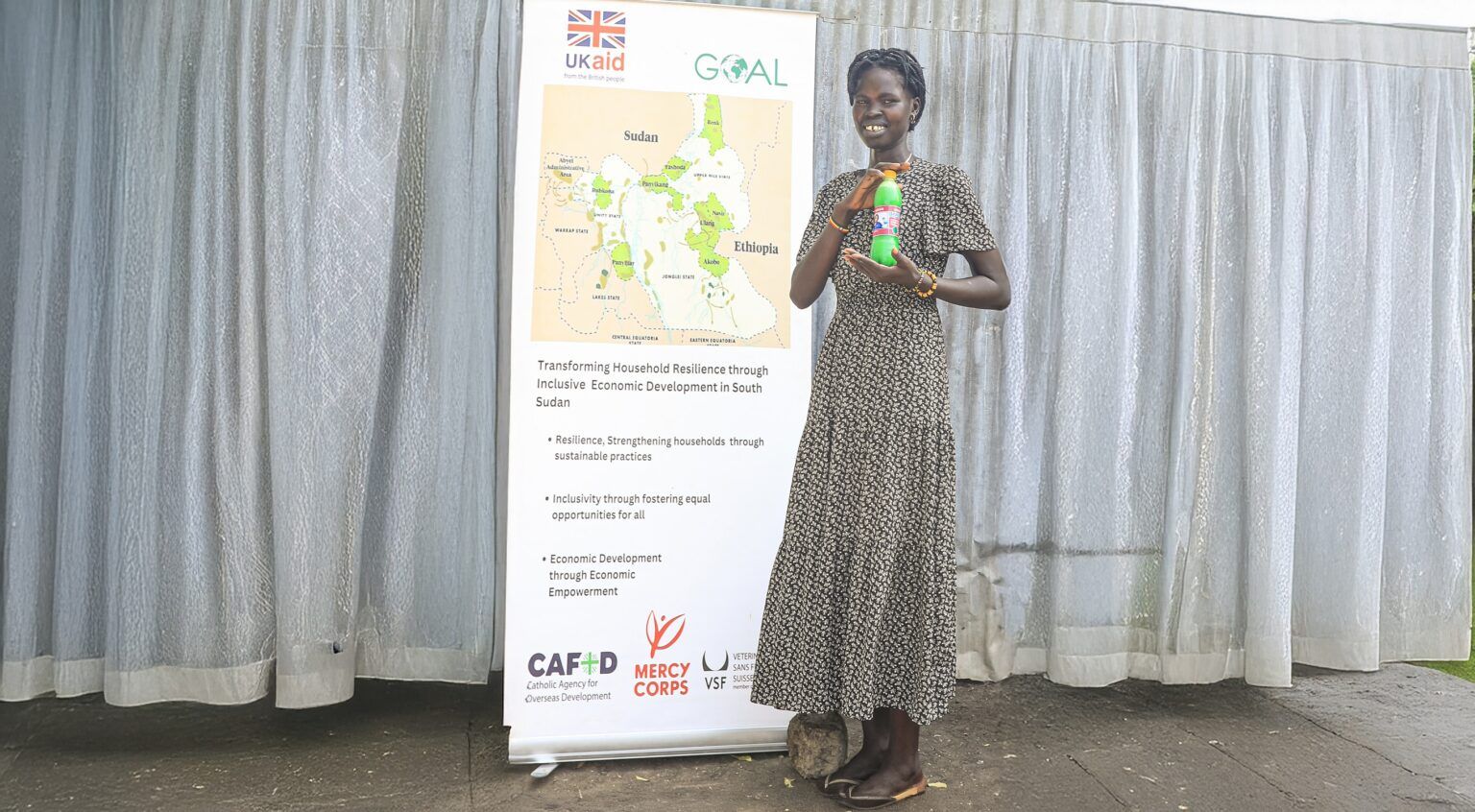
“We knew we were harming the environment by selling firewood and affecting family stability through alcohol sales,” Nyachiang reflected. “But that was the only way we could survive. Now things have changed. We produce something that supports our community, keeps our children and homes clean, and helps us diversify our income. We are grateful to everyone who supported us.”
Building on this success, the women have also opened a beauty salon in the town centre and are exploring additional business opportunities to complement their growing enterprise, strengthening both household resilience and community wellbeing.
Read more about the THRIVE project