

 Stories
August 19, 2026 • 3 min read
For communities in Kenema and Moyamba, long journeys to find safe water have cost women and children valuable time and increased families’ exposure to waterborne diseases. Through its Rural WASH Programme, GOAL Sierra Leone, with support from Charity: Water, has delivered 112 water points, sanitation facilities and community management systems, reaching an estimated 35,000 people each day.
For rural communities across Kenema and Moyamba districts, getting water has long been more than a daily chore. Where safe water points were scarce, women and children walked long distances to collect it time pulled away from school, work and family life. Others relied on unsafe sources, raising the risk of waterborne disease and straining already stretched health services.
When Water Is a Daily Struggle
In rural Sierra Leone, the burden of a distant water source falls hardest on women and girls. Hours spent walking mean less time for children in school and for women to pursue education, livelihoods or family responsibilities. Where safe resources aren’t available, families often turn to unprotected ones instead and the risk follows them home, making it harder for schools and health facilities to stay clean and safe.
Bringing Water Closer to Home
To address these challenges, GOAL Sierra Leone, with support from Charity: Water, worked with communities and local authorities through the Rural WASH Programme to expand access to safe water and improve sanitation.
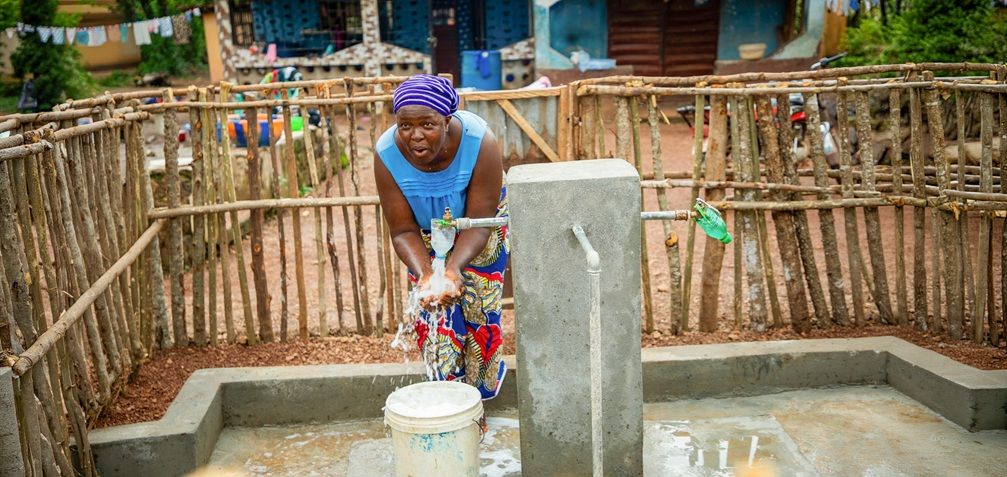
The programme delivered 112 water points including 70 in Kenema District and 42 in Moyamba, providing safe, reliable access for an estimated 35,000 people daily. The investment went further: nine toilet blocks were built, and sanitation was improved at three Peripheral Health Units and three schools. Communities also established and trained Water Management Committees, giving residents the knowledge and structure to manage and maintain the facilities themselves.
At the handover ceremony, GOAL Sierra Leone Country Director James Riak called it more than an infrastructure handover: “It is about improving health, restoring dignity, creating opportunities and transforming lives.”
A Shift in Responsibility
The difference is already visible. More children are spending time in classrooms instead of searching for water. Healthcare facilities deliver better services. Women and girls have more time for education, livelihoods and each other.
At handover ceremonies in Mosongo, Kori Chiefdom (Moyamba District), and Coma Dama (Kenema District), government officials, traditional leaders, community representatives and development partners gathered to mark the completion of the work. Sierra Leone’s Minister of Water Resources and Sanitation, Sao-Kpato Isata Hannah Max-Kyne, commended GOAL’s long-standing partnership with the country and stressed that access to water is fundamental to its wider development. “When water is available, children are safer,” she said. “They no longer have to travel long distances in search of water and can devote more time to their studies and personal development.”
But the handover marks a shift, not an ending. GOAL and its partners have placed community management at the centre of the programme, with trained Water Management Committees now responsible for keeping the facilities running. Local leaders and communities carry the work forward from here.
For the 35,000 people who will use these water points each day, the impact is clear: water is now closer, safer and more reliable. That also means more time for children to stay in school, for women to pursue livelihoods, and for families to care for one another without losing hours searching for water.
The real measure of these 112 water points won’t be the number handed over, but how long do they keep making those everyday possibilities real.
